 How-to
Can You Feed Your Dog Natural Food on a Budget?
Last Updated: October 25, 2026
Quick Summary
You can protect your natural food budget by building cheap base recipes from chicken quarters, rice, and vegetables, then mixing fresh food with kibble to replace 20-30% of meals. Bulk buying meat and staples cuts cost per meal sharply, but only if you portion and freeze properly to avoid spoilage.
- Chicken quarters and frames cost far less than breast meat and give more nutrients per dollar.
- Ground eggshell powder is a cheap calcium source but must be weighed, not eyeballed.
- Tinned sardines in water are usually cheaper per gram of omega-3 than capsules.
- Replace 20-30% of kibble with fresh food and introduce new foods gradually over 7-14 days.
- A common starting guideline for fresh and raw food is 2-3% of body weight per day.
Table of Contents
- Why Natural Feeding Costs More (And Where the Money Actually Goes)
- Homemade Dog Food on a Budget: Building a Base Recipe That Costs Less
- How to Balance Homemade Dog Food Without Expensive Supplements
- Safe Human Foods for Dogs That Stretch Every Meal
- Bulk Buying Dog Food: Where the Real Savings Hide
- Mixing Raw, Cooked, and Kibble: Stretching Natural Food Further
- Calculating Your Dog's Real Daily Cost and Budgeting for Life Stages
- Stocking Your Natural Food Pantry with Best Online Pets Supply
- Frequently Asked Questions
Why Natural Feeding Costs More (And Where the Money Actually Goes)
Feeding your dog natural food on a budget is possible, but first you need to see where the money really goes.
Here is the honest math. A bag of natural kibble costs more than a supermarket brand for three reasons:
- Smaller production runs mean higher cost per bag
- Better ingredients cost more at the farm gate
- Retail markup adds a layer between the maker and your dog
The good news? None of those costs are fixed.
But first, here is what most guides get wrong: they assume natural feeding means expensive cuts of meat and pricey supplements.
WSAVA Global Nutrition Guidelines makes one point clear. A balanced diet matters far more than a fancy one.
Homemade Dog Food on a Budget: Building a Base Recipe That Costs Less
Homemade dog food on a budget starts with a cheap, simple base.
A common mistake is trying to make every meal a gourmet event. Skip that.
Here is a simple base you can scale:
- Protein: chicken quarters or chicken frames (cheap, bone-rich, good value)
- Carb: plain white or brown rice
- Veg: carrots, peas, or pumpkin
Cook the protein, keep the broth, and mix it all together.
The real difference between cheap and expensive homemade food comes down to your protein choice.
Watch out: bones need care. Never feed cooked bones, as they splinter.
How to Balance Homemade Dog Food Without Expensive Supplements
How to balance homemade dog food is the question that stops most people.
You do not need a shelf of powders. You need the right mix of protein, fat, carbs, and a few key nutrients, and a way to check that the mix is actually adequate. Calcium and omega-3s are the two most people miss, and both have cheap sources.
Here is how to cover the common gaps without overspending:
- Calcium: ground eggshell powder or raw meaty bones. Eggshell is mostly calcium carbonate and is cheap, but it must be weighed, not eyeballed, too much calcium unbalances phosphorus and can cause problems, especially in growing puppies.
- Omega-3: tinned sardines in water a few times a week, or a plain fish body oil. Sardines are usually cheaper per gram of omega-3 than capsules.
- Vitamins and minerals: liver once or twice a week for vitamin A, iron, and B vitamins, plus varied vegetables for fiber and micronutrients. Liver is nutrient-dense, so keep portions small.
The part most budget guides skip: verifying adequacy
A cheap diet is only a bargain if it is complete. Two practical checks matter more than any supplement purchase:
- Use a formulation tool or a professional. Free and low-cost recipe formulators exist, but the reliable route is to have a recipe reviewed by a board-certified veterinary nutritionist or a veterinarian comfortable with home-prepared diets. Many veterinary teaching hospitals offer remote consults, and a one-time review is far cheaper than treating a deficiency later.
- Follow a recognized nutrient standard. The WSAVA Global Nutrition Guidelines and the AAFCO Dog Food Nutrient Profiles define what "complete and balanced" means. A homemade diet should be checked against those targets, not against a blog recipe.
WSAVA Global Nutrition Guidelines
Learning to read labels helps here. Our guide on how to read pet food labels shows you what to check so you can confirm balance without buying costly extras.
Safe Human Foods for Dogs That Stretch Every Meal
Safe human foods for dogs are your cheapest budget lever. Many everyday kitchen staples are fine for dogs and cost far less than commercial toppers.
Use them to bulk out meals, add nutrients, or replace pricey extras. Here is a practical list:
- Eggs: cheap protein, cooked or scrambled plain
- Plain yogurt: good for gut health
- Sardines: omega-3s for less than fish oil
Keep the list of foods to avoid firm in your mind. Onion, garlic, grapes, raisins, chocolate, and xylitol are all dangerous (pubmed.ncbi.nlm.nih.gov). Never guess.
A common mistake is overfeeding treats. High-value treats are useful for training, but they add up fast.
Bulk Buying Dog Food: Where the Real Savings Hide
Bulk buying dog food is where the biggest savings sit, but only if you store it right.
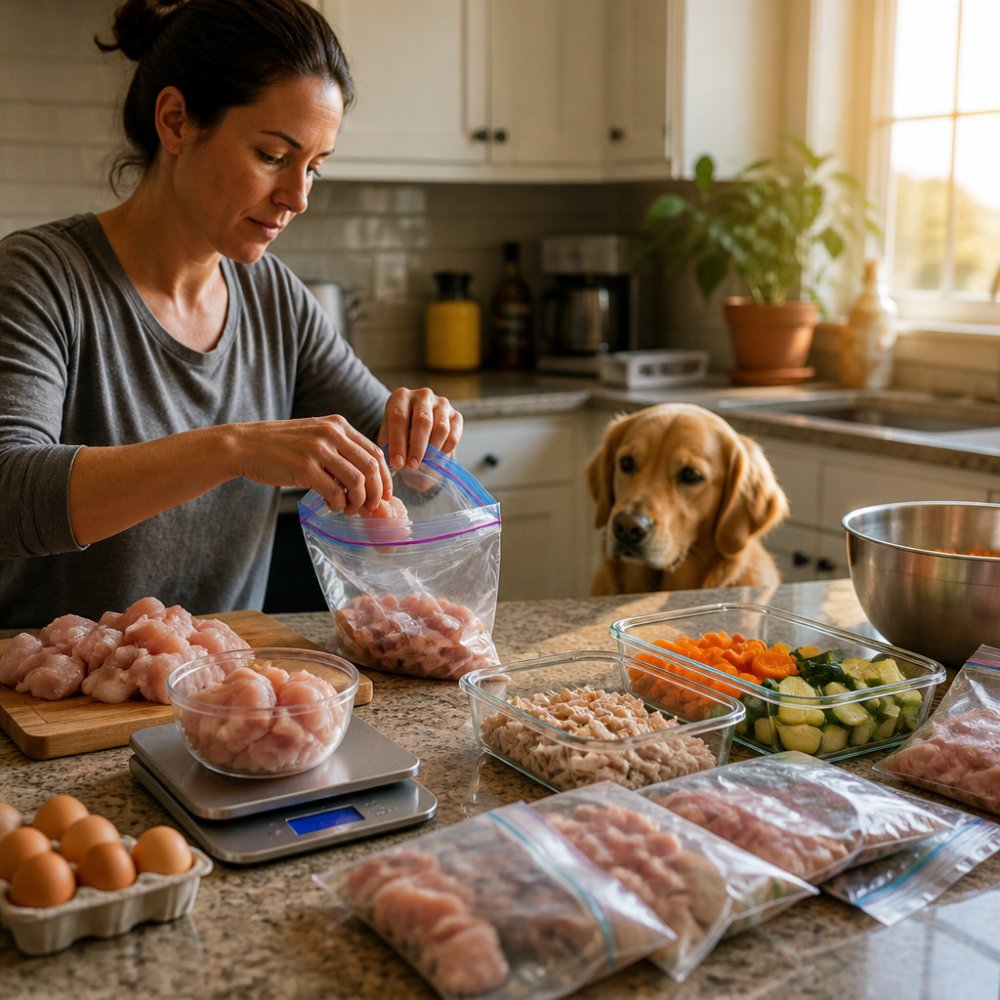
The catch is spoilage. Food waste wipes out your savings faster than any price tag.
A simple system works:
- Portion bulk meat into meal-sized freezer bags the day you buy it
- Label each bag with the date and contents
- Keep a kitchen scale nearby to weigh portions as you bag them
For a full walkthrough on keeping bulk food fresh, read our guide on how to store bulk pet food.
Thawing matters too. Thaw in the fridge, never on the counter.
Mixing Raw, Cooked, and Kibble: Stretching Natural Food Further
Mixing raw, cooked, and kibble is the smartest way to stretch a natural food budget.
This approach is called mixed feeding or partial raw feeding.
A common split is replacing 20-30% of kibble with fresh food. That keeps costs down while adding real nutrition.
Here is how to make the switch safely:
- Introduce new foods gradually over 7-14 days
- Start with a small amount of fresh food mixed into kibble
- Watch your dog's stool and energy as you go
Our guide on switching pet foods gives you a day-by-day plan so the change goes smoothly.
If you are adding kibble to a homemade base, pick a quality one. Our roundup of the best natural dog food helps you choose a kibble worth mixing in.
Calculating Your Dog's Real Daily Cost and Budgeting for Life Stages
Your dog's real daily cost comes down to weight, portion size, feeding approach, and life stage. Most owners guess. A quick calculation gives you a real number to budget around, and lets you compare raw, cooked homemade, and commercial natural food on the same basis.
Step 1: Estimate daily portion
A common starting guideline for fresh and raw food is 2-3% of body weight per day for a healthy adult dog, adjusted for activity. That gives you a rough range:
- Small dog (5 kg): roughly 100-150 g per day
- Medium dog (15 kg): roughly 300-450 g per day
- Large dog (30 kg): roughly 600-900 g per day
These are starting points, not prescriptions. Very active dogs, working dogs, and intact dogs often need the higher end; couch potatoes and seniors often need less. Body condition, ribs easy to feel but not see, is the real check.
Step 2: Work out cost per meal
- Weigh your daily portion on a kitchen scale.
- Divide your pack or batch cost by the number of meals it makes.
- Multiply by 30 for a rough monthly food budget.
A worked example: if a batch of homemade base costs a set amount and yields 20 meals for a 15 kg dog, your cost per meal is batch cost divided by 20. Do the same math for your kibble bag and for a raw premix, and you can compare all three on cost per meal rather than cost per bag.
Step 3: Compare feeding approaches honestly
- Raw: often the highest ingredient cost per calorie, but bulk buying and cheaper cuts (frames, quarters, organ meat) narrow the gap.
- Cooked homemade: similar ingredient cost to raw, plus energy and time; rice and vegetables are cheap volume.
- Commercial natural kibble or complete raw: higher per-bag price but no prep time and guaranteed completeness, which has real value if you are not using a formulator.
A mixed approach, one fresh meal and one complete commercial meal per day, often lands between the two on cost while keeping nutrition covered.
Step 4: Budget for life stages and health needs
- Puppies: eat more per kilogram of body weight and need tighter calcium-to-phosphorus balance. Cheap substitutions can be risky; budget for a complete diet or professional formulation.
- Seniors: often need fewer calories but more digestible protein; portion down rather than switching to a cheaper, lower-quality food.
- Allergies and medical conditions: elimination diets and prescription diets are not areas to economize with random substitutions. Work with your veterinarian.
Use a kitchen scale and track for a month. You will likely find waste, not food cost, is the biggest leak.
A quick weight-based estimate gives you a real daily portion to budget around.
| Dog size | Body weight | Rough daily portion |
|---|---|---|
| Small dog | 5 kg | roughly 100-150 g per day |
| Medium dog | 15 kg | roughly 300-450 g per day |
| Large dog | 30 kg | roughly 600-900 g per day |
| Giant dog | 45 kg | roughly 900-1,350 g per day |
Stocking Your Natural Food Pantry with Best Online Pets Supply
Stocking a natural food pantry is easier when the heavy bags come to your door.
We focus on healthy pet options and simple home delivery.
Here is what helps most:
- Free shipping on orders over $99, so you can stock up in one go
- Many pet supplies in one place
- Home delivery for bulk and heavy items
If you want a reliable delivery option to keep your pantry full, see our guide to the best online pet food delivery.
Ordering in bulk also pairs well with meal planning. Buy once, portion it out, and you cut both cost and hassle.
Frequently Asked Questions
How can I feed my dog natural food on a budget?
Start with affordable proteins like chicken quarters, eggs, and sardines, then add cheap bulk vegetables and rice. Buy in bulk and portion into freezer bags to avoid waste. Mixing 20-30% natural food with kibble keeps costs down while improving nutrition. Track your dog's weight and adjust portions using the 2-3% of body weight guideline. A kitchen scale helps you avoid overfeeding, which is one of the biggest hidden costs in any natural food budget.
Is homemade dog food cheaper than commercial dog food?
It can be, but only if you plan. Chicken, eggs, and seasonal vegetables bought in bulk often cost less per meal than premium commercial food. The savings disappear if you buy expensive cuts or forget supplements. A simple base recipe of chicken, rice, and mixed vegetables, balanced with a vet-approved supplement, usually lands below premium kibble prices. Compare your daily cost per meal before committing to a full switch.
Can I mix natural food with my dog's regular food?
Yes. Partial raw or natural feeding is common and practical. Replacing 20-30% of kibble with natural food lowers your overall cost and adds fresh nutrition. Introduce new foods gradually over a week or two to avoid stomach upset. Keep the total daily portion the same so your dog's weight stays stable, and always check that the combined diet still meets nutritional guidelines.
How can I save money on dog food without compromising nutrition?
Buy chicken and beef in bulk when they are on sale, freeze in meal-sized portions, and use inexpensive toppers like plain yogurt, eggs, and sardines. Choose store-brand frozen vegetables and skip premium treats in favor of high-value homemade ones. A vet or nutritionist check on your recipe ensures you are not missing key nutrients. Bulk buying dog food and meal planning together usually cut feeding costs by a noticeable margin.
Feeding natural food on a budget is not about cutting quality. It is about cutting waste, buying smarter, and balancing meals with cheap, real ingredients. Best Online Pets Supply makes the stocking part simple, with free shipping on orders over $99, a focus on healthy pet options, and home delivery that saves you the heavy lifting. Get started with Best Online Pets Supply and keep your dog's natural diet affordable every month.