 Listicle
9 Best Cat Joint Supplements for 2026, Compared
Quick Summary
Cat joint supplements are products meant to support joint comfort and mobility, usually through ingredients such as glucosamine, chondroitin or green-lipped mussel. They come as powders, chews, capsules and liquids, and the format your cat will accept matters as much as the ingredient list. Most of the research on these ingredients comes from dogs and people, so feline benefits remain plausible rather than firmly established.
- Joint supplements for cats come as powders, chews, capsules and liquids.
- Glucosamine and chondroitin are the most common joint-support ingredients on cat labels.
- Most research on these ingredients comes from dogs and people, not cats.
- Expect to give a supplement consistently for several weeks before judging results.
- Mobility changes can signal pain or illness, so book a veterinary exam first if signs appear suddenly.
Table of Contents
- Quick Comparison: Top Cat Joint Supplements for 2026
- How We Evaluated These Cat Joint Supplements
- Cat Joint Supplement Ingredients: What the Evidence Says
- Product Breakdown: Our Top Picks by Format
- Joint Supplements for Senior Cats: What to Look For
- How Long Cat Joint Supplements Take to Work
- Choosing Your Cat's Joint Supplement and Next Steps
- Frequently Asked Questions
Quick Comparison: Top Cat Joint Supplements for 2026
Last Updated: November 2, 2026
Choosing among the best cat supplements for joint health in 2026 is harder than it should be. Most product pages list the same ingredients, and few explain what those ingredients actually do. This article compares common options by format and ingredients.
Joint supplements for cats are sold as powders, chews, capsules and liquids. A cat joint supplement is a product meant to support joint comfort and mobility, usually through ingredients such as glucosamine, chondroitin or green-lipped mussel. The format you choose matters as much as the ingredient list, because some cats will refuse a powder that others take without fuss.
Here is the quick comparison of the products we reviewed:
| Product | Format | Key Ingredients | Listed Price | Best For |
|---|---|---|---|---|
| Nutramax Cosequin Joint Supplement for Cats | Listed by retailer | Glucosamine, chondroitin | $13.97 | Glucosamine-and-chondroitin fans |
| VetriScience Hip & Joint Powder | Powder | Glucosamine, chondroitin, green-lipped mussel | Not shown | Multi-ingredient powder |
| Vetoquinol Collagen Soft Chews | Soft chew | Collagen | $59.97 | Cats that take treats |
| Summit Animal Health Joint & Mobility Solution | Liquid | Not listed | Not shown | Owners who prefer liquids |
| Hip & Joint Powder (Glucosamine, MSM & Green Lipped Mussel) | Powder | Glucosamine, MSM, green-lipped mussel, chondroitin, vitamin E | Not shown | Multi-ingredient powder |
| Nutramax Cosequin Hip & Joint | Listed by retailer | Glucosamine, chondroitin, omega-3s | $13.97 | Owners wanting omega-3s included |
Pricing depends on quantity, dates, and delivery. Check Best Online Pets Supply's website for current prices or a quote.
How We Evaluated These Cat Joint Supplements
We did not test these products on cats, and we do not claim they work for any particular animal. This article reports what the listings say. It is not a substitute for veterinary advice.
Cat Joint Supplement Ingredients: What the Evidence Says
Most cat joint supplements draw on a short list of ingredients. Some have a longer history of use in dogs and people than in cats, and the evidence in cats is thinner than most product pages suggest. The useful skill is not memorizing ingredient names but separating well-supported compounds from marketing claims, and knowing what a label should tell you before you buy.
Glucosamine and Chondroitin
Glucosamine and chondroitin are the most common joint-support ingredients on cat supplement labels. Glucosamine is an amino sugar involved in the building blocks of cartilage, and chondroitin is a larger molecule often paired with it on the theory that the two work together. Most of the clinical research behind these ingredients comes from dogs and people, not cats, so treat feline benefits as plausible but not firmly established. Several products on the market list both.
When you compare labels, look for the amount per serving rather than the amount per container, and check whether the label states a serving size for your cat's weight. A product that lists glucosamine and chondroitin but hides the milligrams gives you no way to compare it with a competitor.
MSM, Green-Lipped Mussel and Vitamin E
Some products add MSM (methylsulfonylmethane), green-lipped mussel, or vitamin E alongside the core ingredients. MSM is a sulfur-containing compound marketed for joint comfort; green-lipped mussel is a marine source often included for its fatty-acid content; vitamin E is an antioxidant. The Hip & Joint Powder listing names all three, but the listing does not say how much of each ingredient is in a serving. That matters: a longer ingredient list is not automatically a stronger product, and small amounts of several ingredients can be less useful than a well-dosed single ingredient.
How to Judge the Evidence Behind an Ingredient
A practical way to sort claims is to ask three questions. First, is the ingredient a nutrient the body uses, or a proprietary blend with no disclosed amounts? Second, does the product page cite research, or only describe benefits? Third, does the research involve cats, or is it borrowed from dogs and people? Ingredients with a longer research history in other species are not useless, but the honest framing is "may support" rather than "proven to repair." veterinary research on joint supplements in cats
Ingredients That Deserve Extra Caution
Some joint products include additional compounds such as omega-3 fatty acids, collagen, or herbal extracts. Omega-3s are widely used and generally well tolerated, but they can affect clotting at high doses, so tell your vet if your cat is on medication or scheduled for surgery. Collagen is a protein; cats with food allergies or sensitive stomachs may react to a new protein source. Herbal ingredients vary widely in quality and can interact with prescription drugs. None of this means avoid them, it means introduce one new product at a time and watch for digestive upset, itching, or changes in appetite.
Ask your veterinarian whether these ingredients suit your cat's age and health history before you start a course, especially if your cat is already on medication.
Product Breakdown: Our Top Picks by Format
Format often decides which supplement actually gets used. Pick the one your cat will accept every day.
Powders suit owners who want to mix a supplement into food. The VetriScience Hip & Joint Powder combines glucosamine, chondroitin and green-lipped mussel. The multi-ingredient Hip & Joint Powder adds MSM and vitamin E. Pricing depends on quantity, dates, and delivery, so check Best Online Pets Supply's website for current prices or a quote.
Soft chews work for cats that accept treats readily. The Vetoquinol Collagen Soft Chews is a collagen product. Compare cost per day before choosing it.
Liquids suit owners who find pills and chews difficult. The Summit Animal Health Joint & Mobility Solution is a liquid formula. Read the full label before buying.
Capsules and retailer-listed options are often the cheapest route. The Nutramax Cosequin Hip & Joint combines glucosamine, chondroitin and omega-3s. Confirm the package size and serving directions on the product page.
Joint Supplements for Senior Cats: What to Look For
Senior cats are the group most often given joint supplements, and they are also the group where a veterinarian's input matters most. Older cats may have kidney, liver or heart conditions that change which ingredients are safe, and mobility changes can signal pain or illness rather than simple wear and tear. A supplement is one part of a care plan, not a substitute for an exam.
Signs That Warrant a Veterinary Exam
Stiffness is not the only sign of joint discomfort in cats. Watch for a cat that hesitates before jumping, lands heavily, stops using stairs, hides more, or becomes irritable when touched near the hips or shoulders. Changes in grooming, especially a scruffy lower back, can also point to pain. A common pattern is that owners notice the cat is "slowing down" months before they connect it to joint pain.
Whole-Cat Joint Care Beyond Supplements
Supplements work best alongside basic care. Weight management is the single most useful lever: extra weight strains joints, and older or less active cats often carry more than their owners realize. Low-impact activity, short, frequent play sessions and gentle food puzzles, helps maintain muscle without jarring joints. Home adaptations matter too: a low-sided litter box, a ramp or step to a favorite windowsill, and a warm, cushioned bed reduce the daily load on stiff joints.
When you choose a product for an older cat, look for the ingredients named clearly on the label, a stated serving size for your cat's weight, and a manufacturer you can contact. Avoid products that promise to reverse arthritis. A supplement can support joint comfort. It cannot cure joint disease.
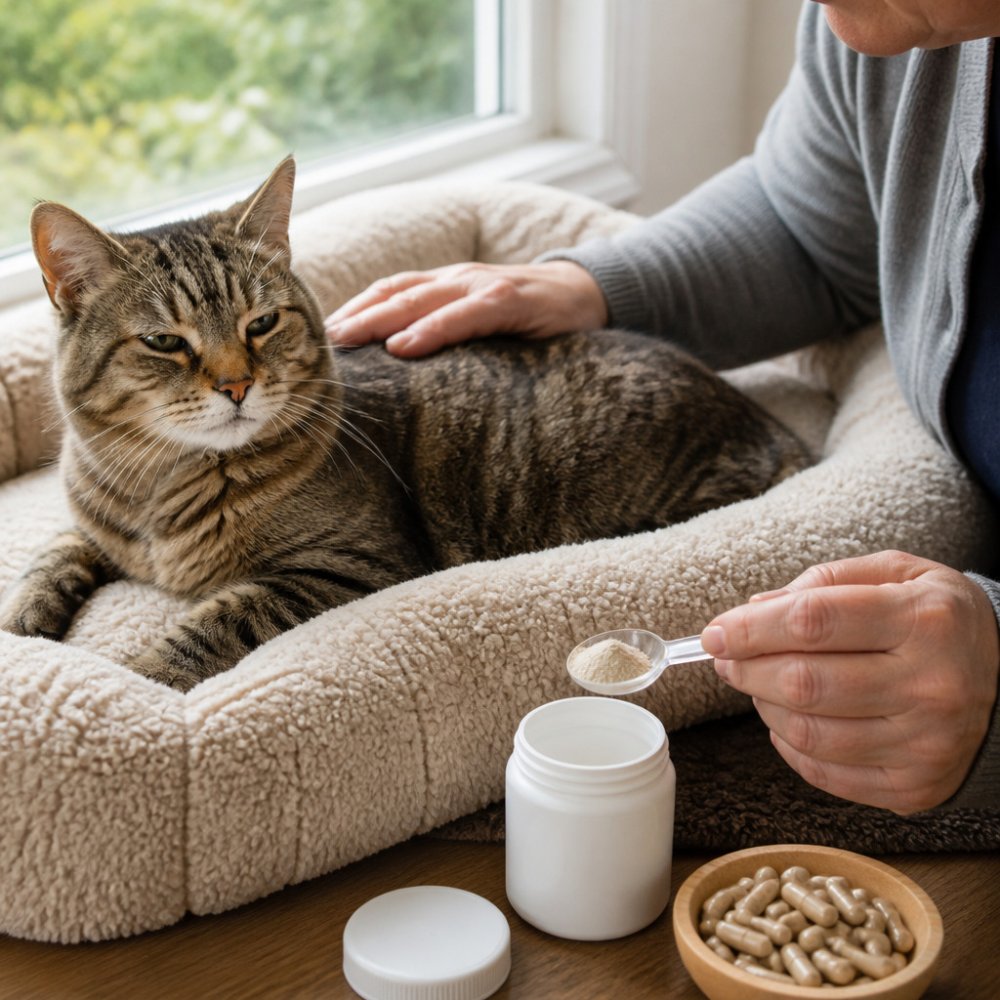
Watch out: many senior cats are already on prescription pain medication or have kidney disease. Check with your vet before adding any supplement to that routine, and ask whether the product's ingredients are appropriate for a cat with reduced kidney function.
How Long Cat Joint Supplements Take to Work
Joint supplements are not fast-acting. Most owners should expect to give a product consistently for several weeks before judging whether it helps. Results vary by cat, by the cause of the stiffness, and by how much the cat moves each day.
Keep a simple log. Note how easily your cat jumps, climbs stairs and gets up from rest, once a week. That record is more useful than memory when you talk to your veterinarian.
Choosing Your Cat's Joint Supplement and Next Steps
Start with the format your cat will actually take, then check the ingredient list against what your vet recommends. Compare the listed price per serving rather than per container. Products with clear labels and stated serving sizes are easier to trust.
Look for the product that combines a recognisable ingredient list, a format your cat accepts, and a price you can sustain for months. If you are buying supplements online, Best Online Pets Supply carries a range of pet care products, and orders over $99 qualify for free shipping. Shop Now to compare options.
For broader guidance, read our guide to senior cat wellness products before choosing a supplement. If your cat also has a sensitive stomach, our guide to gentle cat food helps you pair a new supplement with the right diet. Older or less active cats often carry extra weight that strains their joints, so our best cat food for weight management may be worth reading. And if you are comparing ingredient lists, how to read pet food labels explains what the terms mean.
Frequently Asked Questions
Do joint supplements actually help cats?
Some joint supplements contain ingredients such as glucosamine, chondroitin, MSM, green-lipped mussel and omega-3 fatty acids that are commonly used to support joint function. The strength of evidence differs by ingredient and by product, and the research supplied for this article does not establish that any single product reliably improves mobility in every cat. Results vary with age, activity level and the underlying condition. Speak with your veterinarian before starting any supplement, especially if your cat has an existing diagnosis or takes other medication.
Is glucosamine safe for cats?
Glucosamine is one of the most frequently listed ingredients in cat joint supplements. Cat-specific products are formulated with cats in mind, so avoid giving a cat a supplement made for dogs or people without checking the dose and ingredient list. Watch for changes in appetite, stool or energy after starting a new product, and stop and contact your veterinarian if you notice any adverse reaction. Your vet can advise whether glucosamine suits your cat's health history.
Can I give my cat a human joint supplement?
Human joint supplements are not designed for cats, and their concentrations and added ingredients may not suit feline physiology. Some human products also contain ingredients that can be harmful to pets. Choose a supplement labeled for cats and confirm the serving size for your cat's weight. If you are unsure whether a product is appropriate, ask your veterinarian before giving it.
How long do cat joint supplements take to work?
Most joint supplements are intended for daily, ongoing use rather than a quick fix, so expect to give them consistently for several weeks before judging whether they help. Track your cat's mobility, willingness to jump or climb, and how stiff they seem after rest. Record changes in a simple log and share it with your veterinarian at follow-up visits. If your cat shows no improvement, or seems worse, consult your vet rather than simply increasing the dose.