 Listicle
Best Cat Food for Weight Management: 2026 Guide
Table of Contents
- What Makes Cat Food Effective for Weight Management
- Best Cat Food for Weight Loss: Product Comparison
- How Much to Feed an Overweight Cat
- Safe Weight Loss for Cats: Pace and Monitoring
- Dry Versus Wet Feeding: Calorie Comparison
- Managing Food Transitions and Multi-Cat Households
- Frequently Asked Questions
Last Updated: October 14, 2026
What Makes Cat Food Effective for Weight Management
Weight-management formulas differ from ordinary cat food in three ways: calorie density, protein levels, and fiber content. They cut calories while keeping the nutrients your cat needs during weight loss.
Most contain fewer calories per cup than standard adult foods, plus more fiber to keep your cat full on smaller portions. Protein stays elevated to preserve muscle while fat drops significantly.
The challenge is choosing between dry, wet, or a combination, since each format has different calorie densities and feeding mechanics.
Understanding calories, protein, and fiber makes comparing products far easier.
Best Cat Food for Weight Loss: Product Comparison
When shopping for cat food for weight management, you'll find both prescription and over-the-counter formulas. Over-the-counter options offer flexibility without a veterinary visit, while prescription diets follow stricter guidelines for specific medical situations.
Dry Weight-Management Formulas
Dry kibble is the most popular weight-management option: convenient, shelf-stable, and often lower in calories per serving than wet food.
Solid Gold Weight Management Cat Food uses fresh-caught, omega-rich ingredients in a low-fat, low-calorie profile, emphasizing ingredient quality alongside calorie reduction. Pricing starts at $18.99.
Royal Canin Ultra Light is engineered for weight loss with low calories and high protein to support lean muscle retention.
The advantage of dry food is portion control: you can measure exact amounts and track calories precisely.
Wet Cat Food for Weight Loss Options
Wet food's higher moisture content can increase satiety and reduce calorie intake, since much of the weight comes from water rather than nutrients.
Hill's Science Diet Perfect Weight Roasted Vegetable and Chicken Medley adds fiber and volume through vegetables without significant calorie increases.
Dr. Elsey's Rabbit & Turkey Recipe Pate Wet Cat Food offers a pate texture that some cats prefer over chunky stews.
How Much to Feed an Overweight Cat
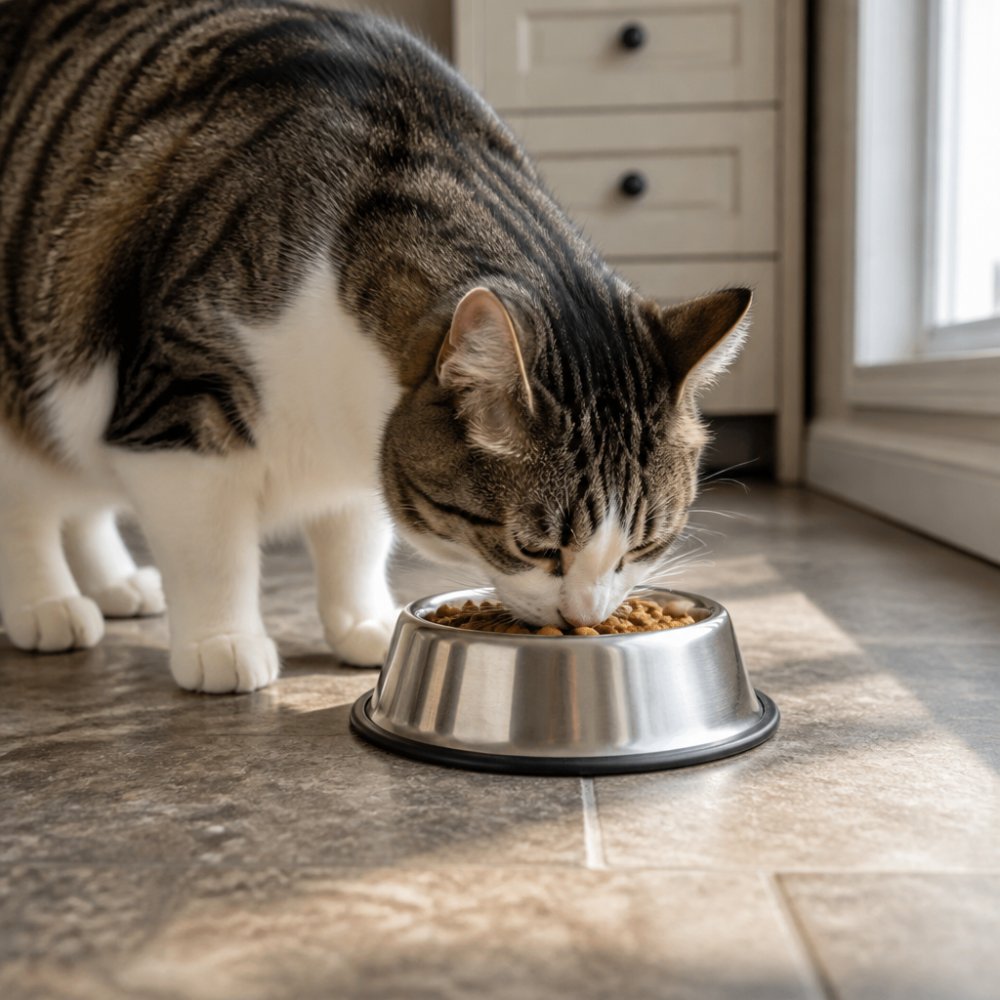
Most feeding advice stops at "feed less and measure portions," leaving the hardest part unanswered: turning a target calorie number into an actual daily bowl. These steps walk through the calculation, then show how to adjust for treats, toppers, and mixed feeding.
Step 1: Find your cat's ideal weight, not current weight
Base calorie needs on the weight your cat should be, not their current weight. If your cat weighs 14 pounds but a healthy target is 10, every calculation starts from 10.
If you're unsure of the ideal weight, ask your veterinarian for a body condition score (BCS). Most clinics use a 1-9 scale where 4-5 is ideal, which is more reliable than a scale number, especially for long-haired or large-framed cats.
Step 2: Estimate resting energy requirement (RER)
A widely used veterinary formula for resting energy requirement is:
RER (kcal/day) = 70 x (ideal body weight in kg)^0.75
To convert pounds to kilograms, divide by 2.2. For a 10-pound ideal weight:
- 10 lb ÷ 2.2 = 4.55 kg
- 4.55^0.75 ≈ 3.12
- 70 x 3.12 ≈ 218 kcal/day RER
That's the energy needed at rest. For weight loss, most veterinarians feed around 80% of RER for a controlled deficit, putting the starting target near 175 kcal/day for this example cat.
Step 3: Convert calories into actual food portions
This is where most owners get stuck.
Dry food example: If a weight-management dry formula provides 320 kcal per cup, then 175 kcal ÷ 320 kcal/cup ≈ 0.55 cup per day.
Wet food example: If a 3 oz can provides 75 kcal, then 175 kcal ÷ 75 kcal/can ≈ 2.3 cans per day.
Notice how different the portion sizes look despite an identical calorie total. That's the key lesson: format changes the volume, not the calorie target.
Step 4: Account for treats and toppers
Treats are the most common reason a measured diet stalls. One medium commercial treat runs 2-5 kcal, and a handful can add 20-40 kcal, or 10-20% of a weight-loss cat's daily budget.
Keep treats and toppers under 10% of daily calories: about 17 kcal, or 4-6 small treats, on a 175 kcal target. Subtract toppers like broth, plain cooked chicken, or a spoon of wet food from the main meal rather than adding them on top.
Step 5: Recalculate every 2-3 weeks
As your cat loses weight, both the target weight and calorie target change. A cat that started at 14 pounds and is now 12 may need a slightly lower total to keep losing safely.
If weight loss stalls for more than 3-4 weeks despite accurate measuring, rule out hidden calories from treats, toppers, or stolen food first. If the diet is truly accurate, talk to your veterinarian before cutting calories further, since very low-calorie diets in cats carry real risks.
Safe Weight Loss for Cats: Pace and Monitoring
The safest pace is 1-2% of body weight per week, or roughly 1.5-3 ounces weekly for a 14-pound cat.
Cats that lose weight too rapidly risk hepatic lipidosis (fatty liver disease), which can develop within days.
Monitor body condition every 2-3 weeks: you should feel ribs easily but not see them prominently, see a waist from above, and see an abdominal tuck from the side.
Watch for these warning signs that weight loss is happening too fast:
- Decreased appetite or refusal to eat
- Lethargy or unusual inactivity
- Vomiting
- Yellowing of ears, gums, or skin
If any of these appear, stop the diet change immediately and consult your veterinarian. Safe weight loss takes months, not weeks.
If progress stalls, adjust portions gradually.
Dry Versus Wet Feeding: Calorie Comparison
The dry-versus-wet debate is usually framed as preference, but for weight management it's a math question. The best format is the one that hits your cat's calorie target consistently while keeping your cat satisfied and your routine manageable.
Calories per serving, side by side
Here's a practical comparison using typical weight-management values. Always check your product's label, since calorie content varies by brand and recipe.
| Format | Typical calorie density | Typical serving size | Calories per typical serving |
|---|---|---|---|
| Dry weight-management formula | 300-360 kcal per cup | 1/4 cup | 75-90 kcal |
| Wet weight-management formula | 70-100 kcal per 3 oz can | 1 can (3 oz) | 70-100 kcal |
| Mixed feeding | Varies | 1/8 cup dry + 1/2 can wet | 40-45 kcal + 35-50 kcal |
Two things stand out: a 3 oz can of wet food and 1/4 cup of dry land in a similar calorie range despite the wet food looking larger, and mixed feeding lets you split the calorie budget across formats for cats who refuse one type.
What the format actually changes
Dry food is calorie-dense because the water is removed, making it easy to measure and store but amplifying small errors. A heaping 1/4 cup instead of level can add 15-25 kcal, meaningful on a 175 kcal budget.
Wet food is calorie-dilute because most of the can is water, so the same calories take up more volume, aiding satiety and hydration.
Mixed feeding combines dry's precision with wet's volume and moisture, often the most practical option for multi-cat households or cats bored by one format.
A simple decision framework
Use these questions to pick a starting format:
- Does your cat free-feed? If yes, dry-only is risky because it is hard to control intake. Start with scheduled meals, regardless of format.
- Does your cat beg or seem hungry after meals? Wet or mixed feeding often helps because the volume is larger for the same calories.
- Does your cat have dental issues or a history of urinary problems? Wet food is often preferred, but confirm with your veterinarian.
- Is cost or convenience the limiting factor? Dry is usually cheaper per calorie and easier to store. Mixed feeding can be a middle ground.
- Are there multiple cats? Mixed feeding can make it easier to give the overweight cat a larger-volume, lower-calorie meal while the other cat gets a different portion.
The number that matters most
Regardless of format, the calorie total drives weight loss. A cat eating 175 kcal from dry and one eating 175 kcal from wet are on the same energy budget. Format affects satiety, hydration, cost, and convenience, but not the underlying math.
Best Online Pets Supply carries both dry and wet weight-management options, making it easy to test different combinations and find what works for your household.
Managing Food Transitions and Multi-Cat Households
Switching foods too quickly causes digestive upset. Transition over 7-10 days, gradually increasing the new food while decreasing the old. Patience prevents food refusal.
Multi-cat households face a specific challenge: keeping the non-overweight cat out of the weight-management food. Feed cats in separate rooms or on different schedules.
If you can't separate cats physically, consider whether the non-overweight cat needs different food at all.
If your cat refuses the new food after a proper transition, try:
- Warming wet food slightly to enhance aroma
- Mixing a small amount of the old food with the new for familiarity
- Trying a different protein source (chicken vs. rabbit vs. fish)
- Adding a small amount of low-sodium broth to dry food
Patience and gradual changes prevent wasted food and stressed cats.
Choosing the right cat food for weight management is about matching calorie content, fiber levels, and your feeding situation.
| Food Type | Calorie Density | Best For | Key Advantage |
|---|---|---|---|
| Dry weight-management formula | 3.5-4 cal/kibble | Precise portion control | Easy to measure and store |
| Wet weight-management formula | 70-100 cal/3 oz | Increased satiety | Higher moisture content |
| Mixed dry and wet | Variable | Variety and flexibility | Combines benefits of both |
Frequently Asked Questions
What is the best food for a cat to lose weight?
The best cat food for weight loss combines reduced calories with high protein and fiber to keep your cat satisfied. Look for formulas labeled as weight-management or perfect-weight options that list real meat as the primary ingredient and include fiber sources like beet pulp or psyllium seed. Both dry and wet foods can work; the choice depends on your cat's preference and your feeding routine. Consult your veterinarian to confirm the food suits your cat's health profile before switching.
How much should I feed my cat to help them lose weight?
Most adult cats need 200-250 calories daily, but overweight cats typically require 25-30% fewer calories to lose weight safely. Measure portions using the feeding guidelines on the food package, adjusted for your cat's target weight rather than current weight. For example, if your cat weighs 6 kg but should weigh 4.5 kg, calculate portions based on 4.5 kg. Divide daily calories into two or three meals to maintain satiety. Weigh your cat weekly and adjust portions if weight loss stalls after 4-6 weeks.
Should I choose wet or dry food for a cat that needs to lose weight?
Both wet and dry weight-management foods can support weight loss. Dry food typically contains fewer calories per serving, while wet food has higher water content, which increases volume and satiety without extra calories. Many cats find wet food more satisfying, making it easier to stick to portion limits. Some owners mix both formats: dry food for convenience and wet food at one meal for variety. Compare the caloric density (calories per 100g) to choose the option that fits your feeding plan.
How quickly should a cat lose weight safely?
Safe weight loss for cats is 0.5-1% of body weight per week. A cat weighing 6 kg should lose no more than 30-60 grams weekly. Faster weight loss can trigger hepatic lipidosis (fatty liver disease), a serious condition. Expect visible results in 8-12 weeks. Weigh your cat every 2-4 weeks and monitor body condition. If weight loss stalls, do not further reduce calories without veterinary guidance; instead, increase activity or adjust the food formula. Stop the weight-loss plan once your cat reaches the target weight.
What ingredients should I look for in weight-management cat food?
Prioritize foods with real meat (chicken, turkey, or fish) as the first ingredient, which provides protein to preserve muscle during weight loss. Look for soluble and insoluble fiber sources like beet pulp, psyllium seed, or oats, which increase satiety. Reduced-fat formulas (typically 8-12% fat) lower calorie density compared to standard adult foods. Avoid grain-free options unless your vet recommends them; they often contain higher-calorie substitutes. Check the guaranteed analysis on the label for protein (at least 30% in dry food, 8-10% in wet food) and fiber content.