 How-to
How Do You Start Raw Feeding a Cat Safely?
Quick Summary
To start raw feeding a cat safely, first do a risk assessment with your veterinarian, then choose a nutritionally complete diet and switch gradually over seven to fourteen days. Strict food handling is essential because raw meat can carry harmful bacteria for both your cat and your household.
- Kittens, pregnant queens, and cats with weakened immune systems or chronic illness generally should avoid raw diets.
- Thaw raw food in the refrigerator, not on the counter, allowing roughly 12 to 24 hours for a typical portion.
- Transition gradually: about 25% raw in days 1-3, then 50%, 75%, and fully raw by day 14.
- Discard uneaten raw food after about 20 to 30 minutes at room temperature and clean bowls after every meal.
- Stop the switch and call your vet if vomiting or diarrhea lasts over 24 hours or your cat refuses food for a day or more.
Table of Contents
- What Raw Feeding Means for Cats and How It Differs From Other Diets
- Is Raw Feeding Safe for Your Cat? Veterinary Risk Assessment
- Choosing a Nutritionally Complete Raw Diet: Commercial, Homemade or Balanced Recipe
- Working Out How Much to Feed: Portions, Meal Frequency and a Raw Cat Food Calculator
- Transitioning Your Cat Gradually From Kibble or Canned Food
- How to Transition a Picky Cat to a Raw Diet
- Raw Food Diet for Cats: Pros and Cons, Food Safety and Costs
- Your First Week of Raw Feeding: Monitoring Your Cat and Knowing When to Stop
- Frequently Asked Questions
How Do You Start Raw Feeding a Cat Safely?
Last Updated: November 5, 2026
What Raw Feeding Means for Cats and How It Differs From Other Diets
Raw feeding means giving your cat uncooked meat, bones, organs, and sometimes produce. Best Online Pets Supply has put together this guide to help you start safely, and if you're looking for a convenient way to get started, their Free Shipping offer on orders with a $99.00 minimum can help keep delivery costs down.
Raw feeding is built around the idea that cats are obligate carnivores. Their bodies process meat-based nutrition well. Raw diets skip the cooking step that many commercial foods use.
Here is how raw feeding usually differs from other options:
- Kibble: Dry, cooked, and shelf-stable. Often higher in carbohydrates.
- Canned food: Wet and cooked. Higher moisture than kibble.
- Raw: Uncooked meat-based food. Usually fresh or frozen, with moisture from the meat itself.
Raw food is not a single product. Some owners buy commercial frozen raw patties. Others mix their own meals from a balanced recipe.
Is Raw Feeding Safe for Your Cat? Veterinary Risk Assessment
Raw feeding is not a one-size-fits-all choice. Before you buy anything, do a risk assessment with your veterinarian framed as three questions: Is this cat medically suitable? Is this household safe? Can the owner realistically manage raw food handling every day? A "no" to any one is a reason to pause, not a reason to feel judged.
Cats that should generally avoid raw diets
Some cats face elevated risk from foodborne bacteria or nutritional imbalance. Veterinary practice commonly advises against raw feeding, or requires close supervision, for:
- Kittens and growing cats. Growth diets have tight calcium-to-phosphorus and energy requirements, and an imbalanced homemade recipe can cause developmental bone problems. Use a commercial diet labeled "complete and balanced" for growth, or a recipe from a board-certified veterinary nutritionist.
- Pregnant and nursing queens. Nutrient needs rise sharply, and foodborne illness can affect mother and kittens.
- Cats with weakened immune systems. This includes cats with feline immunodeficiency virus (FIV), feline leukemia virus (FeLV), or those on immunosuppressive drugs such as corticosteroids or chemotherapy.
Household risk factors
Raw meat can carry Salmonella, Listeria, Campylobacter, and E. coli. Cats can shed these organisms without showing symptoms, which means the risk extends beyond the cat. Extra caution, or choosing a cooked or commercial complete diet instead, is reasonable when the household includes:
- Children under five years old
- Older adults
- Pregnant people
If any of these apply, discuss the trade-offs with your vet before starting. A cooked homemade diet formulated to the same standards can reduce pathogen exposure while still giving you control over ingredients.
Questions to ask your vet before switching
Bring a short list to the appointment so the conversation is efficient:
- Is my cat healthy enough for a raw diet, based on a physical exam and any recent bloodwork?
- Does my cat have any condition that changes nutrient targets (kidney, heart, urinary, or endocrine disease)?
- Are there vaccinations, parasite prevention, or screening tests you recommend first?
Screening tests and baseline data
Establish baseline data before the switch so you can compare later. Your vet may recommend a physical exam, body weight and body condition score, and basic bloodwork including a chemistry panel and complete blood count.
Watch out: Do not start a raw diet for a cat that is already unwell, losing weight, or showing vomiting or diarrhea. Resolve the health issue first, then revisit the diet decision with your vet.
Choosing a Nutritionally Complete Raw Diet: Commercial, Homemade or Balanced Recipe
You have three main options. Each one can work well when it is complete and balanced.
- Commercial raw: Pre-portioned, frozen, and formulated for cats. The easiest route.
- Homemade with a balanced recipe: You build meals from a tested recipe. More time and planning.
- DIY without a recipe: Not recommended. Random meat and bones often miss key nutrients.
Read any product label carefully. It should name the life stage it meets, such as adult maintenance or growth.
How to Verify a Recipe Is Nutritionally Complete
Check any homemade recipe before you feed it. A complete recipe should meet the cat's needs for protein, fat, calcium, phosphorus, taurine, and vitamins.
Use this checklist:
- The recipe was formulated by a board-certified veterinary nutritionist or a published, tested source
- It lists exact amounts in grams, not vague "a handful"
- It includes organ meat in a small share of the diet, not most of it
Ask your vet to review the recipe. Some owners pay a nutritionist for a custom formulation; ask for a quote before you commit. If you would rather source a ready-made option, you can browse organic cat food online.
Working Out How Much to Feed: Portions, Meal Frequency and a Raw Cat Food Calculator
Portion size depends on your cat's weight, age, activity, and body condition. Many owners start with a general guideline and adjust over time.
Use these simple steps:
- Weigh your cat.
- Check the feeding guide on your food's label.
- Start at the lower end of the range.
- Watch body condition over two to three weeks.
- Adjust portions up or down as needed.
A raw cat food calculator can estimate daily calories from your cat's weight and activity level.
Most adult cats eat two meals a day. Some do well with one larger meal. Kittens usually need more frequent meals.
Transitioning Your Cat Gradually From Kibble or Canned Food
Switch slowly over seven to fourteen days. A sudden change can upset your cat's stomach. Gradual steps give the gut time to adjust.
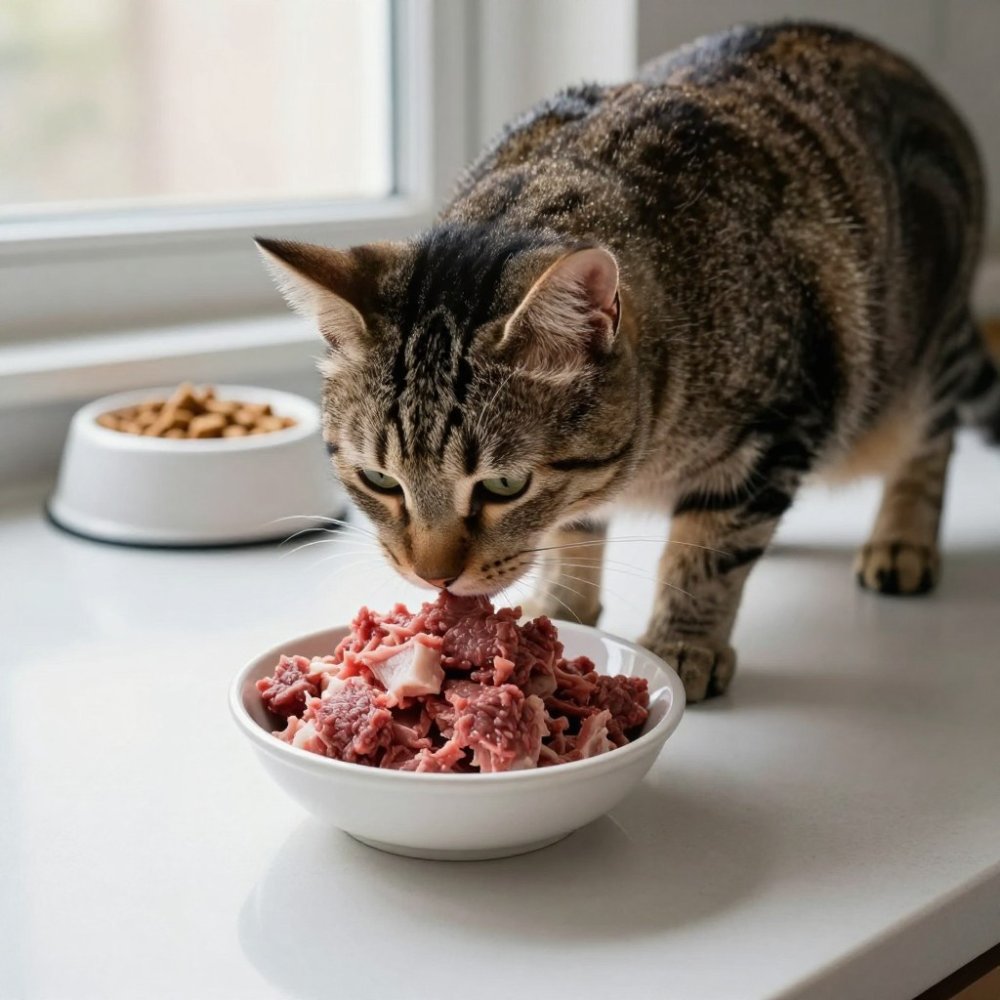
Try this plan:
- Days 1-3: Mix about 25% raw food with 75% current food.
- Days 4-7: Move to a 50/50 mix.
- Days 8-10: Use 75% raw and 25% current food.
Keep the raw food cold until serving. Discard any uneaten raw food after about 20 to 30 minutes at room temperature.
Watch for loose stools, vomiting, or refusal to eat. If your cat has a sensitive stomach, find foods suited to sensitive digestion before going further.
How to Transition a Picky Cat to a Raw Diet
Picky cats can take longer to switch. Patience matters more than speed.
Some tips that help:
- Warm the raw food slightly to bring out the smell. Do not microwave it.
- Try different proteins, like chicken, rabbit, or turkey, to find a favorite.
- Mix a small amount of the new food into a treat your cat already enjoys.
Watch out: Do not skip meals to force your cat to eat. A cat that stops eating for more than a day or two can develop serious liver problems. Call your vet if your cat refuses food for 24 hours or more.
Raw Food Diet for Cats: Pros and Cons, Food Safety and Costs
Raw feeding has real benefits and real drawbacks, and the drawbacks are mostly about handling and planning rather than the food itself.
Possible benefits
- Many owners report a shinier coat, firmer stool, and better appetite.
- Ingredients are often easier to read than in many processed foods.
- You control the protein sources and portion sizes.
These are owner-reported outcomes. Controlled studies comparing raw and commercial diets in cats are limited, so treat benefits as possible rather than guaranteed.
Possible drawbacks
- Pathogen risk to the cat and to people in the household
- Higher cost than most kibble
- More time for thawing, portioning, feeding, and cleaning
Food safety: cross-contamination precautions
Raw meat is the starting point for pathogens, so the goal is to keep those organisms out of the cat's bowl, off your counters, and away from people. A practical routine:
- Thaw in the refrigerator. Place the sealed portion on a plate on the bottom shelf so drips cannot reach other food. Allow roughly 12 to 24 hours for a typical portion. Do not thaw on the counter.
- Use dedicated equipment. Keep a separate cutting board, knife, and bowl for raw meat. Color-coded boards make this easy to remember.
- Wash hands first and last. Wash with soap and warm water for at least 20 seconds before and after handling raw food, and again after cleaning up.
Watch out: Do not let your cat lick the spoon, the cutting board, or your hands during preparation. That is a direct path for bacteria from the kitchen to the cat and back to you.
Vulnerable household members
If your household includes young children, older adults, pregnant people, or anyone immunocompromised, treat raw feeding as a higher-risk choice. Keep the cat's feeding area separate from where people eat, clean it after every meal, and consider whether a cooked homemade or commercial complete diet would meet your goals with less pathogen exposure. Discuss the trade-offs with your vet.
Realistic cost, equipment, and time
Costs vary widely by brand, protein, and delivery frequency, so price it for your own cat.
Startup equipment to budget for:
- A kitchen scale that measures in grams
- A dedicated cutting board and knife for raw meat
- Airtight containers or freezer bags for portioning
Ongoing costs to compare:
- Commercial raw: priced per patty, tub, or pound, plus delivery. Compare cost per day at your cat's portion size, not cost per package.
- Homemade: meat, organ meat, bone or calcium supplement, taurine, fish oil, vitamin E, and other recipe ingredients, plus any formulation review.
- Hidden costs: freezer space, electricity, and your time.
Time per week:
- Thawing and portioning: plan for a weekly session rather than daily scrambling.
- Meal prep and cleanup: a few minutes per meal, more if you are weighing ingredients.
- Shopping: commercial raw is a delivery or pickup task; homemade involves sourcing multiple ingredients.
Run a one-week trial budget before committing. Price the food, list equipment you do not already own, and estimate weekly prep time.
For current prices and available formats, visit the Best Online Pets Supply website.
The main safety steps for handling raw food at home, drawn from the food safety section above, are summarised below.
| Step | What to do | Timing |
|---|---|---|
| Thaw | Thaw in the refrigerator on a plate on the bottom shelf | Roughly 12 to 24 hours |
| Hands | Wash with soap and warm water before and after handling | At least 20 seconds |
| Serve | Offer raw food at room temperature | No more than about 20 to 30 minutes |
| Clean up | Wash counters and utensils with hot soapy water, then sanitize | Immediately after use |
| Bowls | Wash the cat's bowl with hot soapy water or a dishwasher | After every meal |
| Leftovers | Discard uneaten raw food, do not refrigerate it | After 20 to 30 minutes |
Your First Week of Raw Feeding: Monitoring Your Cat and Knowing When to Stop
The first week is when you learn how your cat handles the change. Keep a simple daily log.
Track these signs:
- Appetite and how fast your cat eats
- Stool firmness and frequency
- Vomiting or signs of stomach upset
Stop the switch and call your vet if you notice:
- Vomiting or diarrhea that lasts more than 24 hours
- Refusal to eat for a day or more
- Lethargy, weakness, or hiding
Raw feeding can be a rewarding choice for the right cat. Start slowly, choose a complete diet, and keep food handling careful. Work with your vet, and you can make the switch safely.
Frequently Asked Questions
How do I start feeding my cat a raw diet?
Start by choosing a complete and balanced raw diet, either a commercial product labelled as complete for cats or a recipe checked by a veterinary nutritionist. Store and thaw the food safely, then introduce it gradually over one to two weeks, mixing small amounts into the current food. Watch stool quality, appetite and energy each day, and talk to your vet before you begin, especially if your cat has a health condition.
How do I transition a picky cat to a raw diet?
Many picky cats refuse raw food at first, so go slowly. Warm the food slightly to bring out its smell, offer small portions at the same times each day, and mix only a little raw into a favourite food. Do not let your cat go without eating for long, since fasting can cause serious problems in cats. If refusal continues after several weeks, ask your vet for advice.
Is a raw diet safe for cats?
Raw diets carry risks, including Salmonella, Listeria and E. coli, which can affect both cats and people in the household. Cats with kidney disease, a weakened immune system or who are pregnant or very young may need to avoid raw feeding altogether. Use strict hygiene, clean bowls and surfaces after each meal, and discuss the decision with your veterinarian first.