 blog
Best Grain Free Cat Food: 2026 Guide to Feeding Your Cat
Table of Contents
- Why Grain-Free Cat Food Benefits Your Feline
- How to Choose the Best Grain Free Cat Food
- Step 1: Confirm the food is actually complete and balanced
- Step 2: Check taurine on the guaranteed analysis
- Step 3: Evaluate the protein source and its position
- Step 4: Match the format to your cat's needs
- Step 5: Read the guaranteed analysis, not the marketing
- Ingredients to look for and ingredients to avoid
- Budget-friendly grain-free strategies
- A quick comparison checklist
- Cat Food for Sensitive Stomachs: Finding the Right Match
- Sensitivity, allergy, or something else?
- Signs that a food isn't working
- The elimination diet: the only reliable way to identify a trigger
- Grain-free vs. hypoallergenic vs. limited ingredient: what's the difference?
- What to look for in a sensitive-stomach formula
- Digestibility matters more than the ingredient list
- How to Transition Cat Food Without Upsetting Digestion
- Life Stage Nutrition: Grain-Free Food for Kittens, Adults, and Seniors
- Budget-Friendly Grain-Free Strategies and Environmental Considerations
- Frequently Asked Questions
Last Updated: September 23, 2026
Why Grain-Free Cat Food Benefits Your Feline
Grain-free options now dominate pet aisles, and many owners report better digestion, energy, and coat condition after switching. This guide from Best Online Pets Supply covers what matters when choosing the best grain free cat food for your cat in 2026.
The benefits owners most commonly report include:
- More consistent digestion and firmer stools
- Steadier energy levels throughout the day
- Reduced itching and skin irritation in sensitive cats
- Better weight management for indoor, less active cats
How Grain-Free Diets Support Digestion and Energy
Cats lack the enzymes to break down large amounts of carbohydrate, so when grains dominate the bowl, some struggle to extract nutrition. Switching to animal-based protein often means smoother digestion and steadier energy, with adjustments taking one to two weeks (longer for older cats). Grain-free alone doesn't guarantee quality, a formula can drop grains and still lean on potato starch or pea protein as cheap fillers, so read the guaranteed analysis, not the front of the bag.
The Grain-Free vs. DCM Controversy: What Cat Owners Should Know
The category's biggest controversy is dilated cardiomyopathy (DCM), which made headlines when the FDA investigated possible links to certain grain-free diets in dogs. That investigation focused on dogs, no definitive cause was established, and cats were not the primary subject. In cats, DCM is most strongly linked to taurine deficiency, an amino acid essential to feline heart health (pubmed.ncbi.nlm.nih.gov).
How to Choose the Best Grain Free Cat Food
The best grain-free cat food matches your cat's protein needs, life stage, and digestive tolerance, not the loudest packaging. Here's a repeatable framework you can run on any bag or can in under five minutes.
Step 1: Confirm the food is actually complete and balanced
Before ingredients or protein percentages, confirm the label carries an AAFCO nutritional adequacy statement, the most important line on the package, usually printed in small type near the guaranteed analysis. If it's missing, the food is not a complete diet, no matter how good the ingredient list looks.
Step 2: Check taurine on the guaranteed analysis
Taurine is an essential amino acid cats cannot synthesize enough of on their own; deficiency is a well-documented cause of dilated cardiomyopathy (DCM) and retinal degeneration. Any complete cat food must meet AAFCO minimums for taurine, but verify it appears on the guaranteed analysis or ingredient list.
Step 3: Evaluate the protein source and its position
The first ingredient should be a named animal protein: chicken, turkey, salmon, venison, rabbit, or similar. "Meat meal," "poultry by-product meal," and "fish meal" without a species name tell you nothing about quality. Check the next two or three ingredients too, a formula can lead with chicken and still be built mostly on pea protein, potato starch, or chickpeas.
Step 4: Match the format to your cat's needs
Wet and dry grain-free foods serve different purposes, and many owners use both.
| Format | Moisture Content | Best For | Watch Out For |
|---|---|---|---|
| Wet canned | High (typically 75-80%) | Urinary health, picky eaters, seniors, cats that don't drink enough | Higher cost per meal |
| Dry kibble | Low (typically 6-10%) | Convenience, multi-cat homes, budget | Lower moisture intake |
| Mixed feeding | Moderate | Most adult cats | Portion control and calorie math |
Step 5: Read the guaranteed analysis, not the marketing
The guaranteed analysis gives minimums and maximums for protein, fat, fiber, and moisture. Two foods can both say "high protein" on the front and differ by 15 percentage points on the back, compare the numbers, not the claims. Benchmarks for adult cats: protein roughly 30% or higher on a dry-matter basis, fat typically 15-20%, fiber around 2-5%.
Ingredients to look for and ingredients to avoid
Prioritize:
- Animal-based protein first, with a named species
- Taurine on the guaranteed analysis or ingredient list
- Omega fatty acids (EPA and DHA) for skin, coat, and immune function
- Functional ingredients like probiotics and pumpkin for gastrointestinal support
Avoid or scrutinize:
- By-products of unspecified origin
- Artificial preservatives like BHA, BHT, and ethoxyquin
- Excess fillers such as corn gluten, wheat middlings, or unnamed starches
- Added sugars or artificial colors
Non-GMO labeling is a transparency plus but not a nutritional requirement.
Budget-friendly grain-free strategies
Grain-free doesn't have to mean premium-priced. The strategies that save the most are the least glamorous:
- Buy the largest size your cat has already accepted. Cost per meal drops with larger bags and cases, but only after you know your cat will eat it.
- Freeze extra wet food in portioned containers. Split large cans or cases into single-meal portions and thaw as needed.
- Rotate between two or three trusted formulas. This prevents fixation on a product that might be discontinued or reformulated.
- Compare cost per 100 calories, not per pound. A denser, higher-protein food often costs less per day than a cheaper food your cat needs to eat more of.
A quick comparison checklist
Run these five checks in order:
- AAFCO nutritional adequacy statement present?
- Taurine listed on the guaranteed analysis or ingredients?
- First ingredient a named animal protein?
- Protein, fat, and fiber in a reasonable range for your cat's life stage?
- Format (wet, dry, or mixed) appropriate for your cat's hydration and health needs?
Pass all five and it's worth a trial; fail any and keep looking.
Cat Food for Sensitive Stomachs: Finding the Right Match
"Sensitive stomach" is one of the most overused phrases in pet food marketing, and it hides three very different problems. Before switching foods, know which one you're dealing with.
Sensitivity, allergy, or something else?
Food sensitivities (intolerances) are digestive reactions that don't involve the immune system, vomiting, loose stools, gas, or appetite loss, and tend to be dose-dependent.
Signs that a food isn't working
- Vomiting shortly after meals, especially repeatedly
- Loose stools lasting more than a few days
- Excessive gas or audible stomach gurgling
- Itching, over-grooming, or hair loss, particularly around the head and neck
- Gradual weight loss despite normal appetite
If symptoms persist after a switch, or if your cat is losing weight or acting unwell, see your veterinarian. Diet changes are not a substitute for diagnosis.
The elimination diet: the only reliable way to identify a trigger
If you suspect a food sensitivity or allergy, the gold standard is an elimination diet:
- Choose a novel protein your cat has never eaten, rabbit, venison, duck, or alligator. "Novel" is relative to your cat's history, not the market.
- Feed only that diet for 8-12 weeks. No treats, table scraps, flavored medications, or other pets' food. A single slip resets the clock.
- Watch for improvement. If symptoms resolve, you have a candidate trigger in the old diet.
- Reintroduce one ingredient at a time. If symptoms return, you've identified the trigger; if not, the problem may not have been food-related.
Grain-free vs. hypoallergenic vs. limited ingredient: what's the difference?
These three labels are often used interchangeably, and they are not the same thing.
| Label | What it means | What it does not mean |
|---|---|---|
| Grain-free | Contains no wheat, corn, rice, or other grains | Does not mean hypoallergenic or low-carb |
| Limited ingredient diet (LID) | Fewer ingredients, often a single animal protein and a single carbohydrate source | Does not guarantee the protein is novel to your cat |
| Hypoallergenic | Usually refers to hydrolyzed or novel-protein diets designed to reduce allergic response | Not a regulated term; check the actual protein source |
What to look for in a sensitive-stomach formula
- A single, named animal protein as the first ingredient
- A single carbohydrate source (pea, potato, or similar) rather than a blend
- Probiotics or pumpkin for gastrointestinal support
- Clear AAFCO compliance and taurine on the guaranteed analysis
- A short ingredient list so you can actually identify a trigger if one appears
Avoid artificial preservatives, unnamed by-products, and formulas with long, blended ingredient lists that make it impossible to isolate a cause.
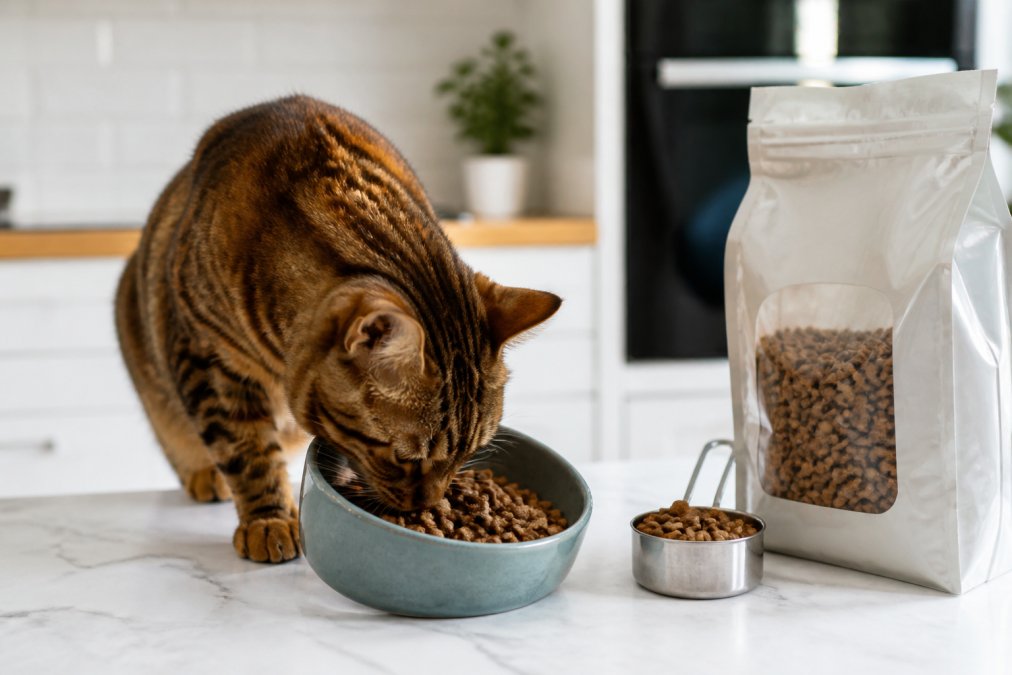
Digestibility matters more than the ingredient list
How to Transition Cat Food Without Upsetting Digestion
The right way to transition cat food is gradual: over seven to ten days, mixing increasing amounts of the new food into the old. A sudden switch is the most common cause of digestive upset during a diet change.
A workable schedule:
- Days 1-2: 75% old food, 25% new
- Days 3-4: 50% old, 50% new
- Days 5-6: 25% old, 75% new
- Days 7-10: 100% new food
Life Stage Nutrition: Grain-Free Food for Kittens, Adults, and Seniors
Life stage nutrition isn't marketing language. Kittens need roughly twice the calories per pound of body weight that adults do, plus more protein and amino acids for growth. Adult formulas focus on maintenance and metabolic health. Seniors often need fewer calories but more support for kidney function, joints, and immune health.
| Life Stage | Key Nutritional Focus | Feeding Notes |
|---|---|---|
| Kitten | High protein, DHA, calcium | Free-feeding often works |
| Adult | Maintenance protein, taurine | Twice daily, measured portions |
| Senior | Kidney support, easy digestibility | Smaller, more frequent meals |
Budget-Friendly Grain-Free Strategies and Environmental Considerations
Environmental impact of protein sourcing is a growing consideration, with insect-based and sustainably sourced fish proteins appearing in more formulas. If sustainability matters to you, look for brands that publish sourcing information.
Frequently Asked Questions
Do vets recommend grain-free food for cats?
Veterinarians recommend grain-free food when a cat has a confirmed grain allergy or sensitivity, which is less common in cats than in dogs. For most cats, grains like rice and oats are digestible. If you suspect a food sensitivity, work with your vet to identify the trigger. A limited ingredient diet or novel protein formula can help isolate the problem before switching to grain-free permanently.
What are the benefits of grain-free cat food?
Grain-free cat food benefits include higher animal-based protein content, which matches a cat's natural carnivorous diet. Many grain-free formulas replace fillers with nutrient-rich ingredients like peas, sweet potatoes, or lentils. This can support better digestion, steadier energy, and healthier skin and coat. Cats with food sensitivities may also see fewer digestive upsets when grains are removed and protein sources are simplified.
How do I transition my cat to a grain-free diet?
Transition over 7 to 10 days by mixing increasing amounts of the new food with the old. Start with 25% new food and 75% old for three days, then move to 50/50, then 75/25, and finally 100% new. Watch for vomiting, diarrhea, or refusal to eat. If your cat has a sensitive stomach, extend the transition to two weeks. Always keep fresh water available and consult your vet if symptoms persist.
Is grain-free cat food better for cats with allergies?
Grain-free food helps only if your cat is allergic to grains, which is rare. Most cat allergies trace back to animal proteins like chicken or beef. A limited ingredient diet with a novel protein, such as venison or duck, often works better than simply removing grains. If your cat scratches constantly or has chronic digestive issues, ask your vet about an elimination diet to pinpoint the actual allergen before choosing a new food.